When Should Wearable Products Become E-Textiles? A Practical Development Guide
More wearable products are being redesigned as e-textiles, but textile integration is not always the right answer. This article explains when e-textiles make sense, what changes during development, and why successful products require more than just working electronics.
BLOG POSTS
4/26/202610 min read
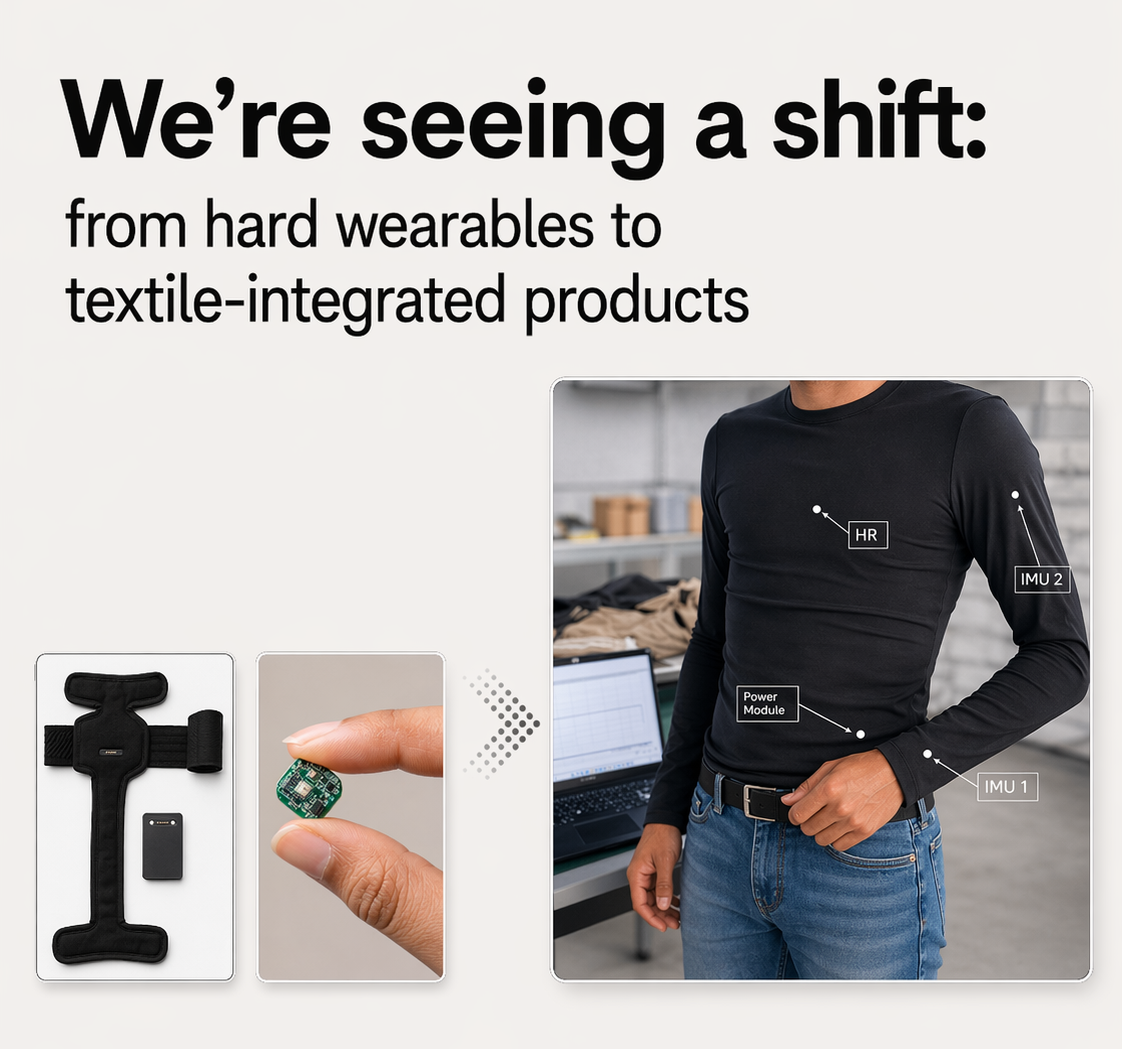
Wearable technology has come a long way from simple body-worn devices. Many products that were once designed as hard, rigid, or semi-rigid wearables are now being reconsidered as textile-integrated systems.
This shift is not happening just because e-textiles sound innovative.
It is happening because, in many applications, textiles can solve problems that traditional hard wearables struggle with.
Comfort, body fit, wear duration, multiple sensing points, and user acceptance are all becoming more important as wearable products move from short-term use into continuous or repeated real-world use.
But that does not mean every wearable product should become an e-textile.
In fact, one of the biggest mistakes in early-stage wearable development is assuming that textile integration is automatically the better solution. E-textiles can create major advantages, but they also introduce new design, validation, and manufacturing challenges.
For anyone new to the terminology, it is also useful to understand the difference between smart textiles and electronic textiles, because not every textile-integrated product uses electronics in the same way.
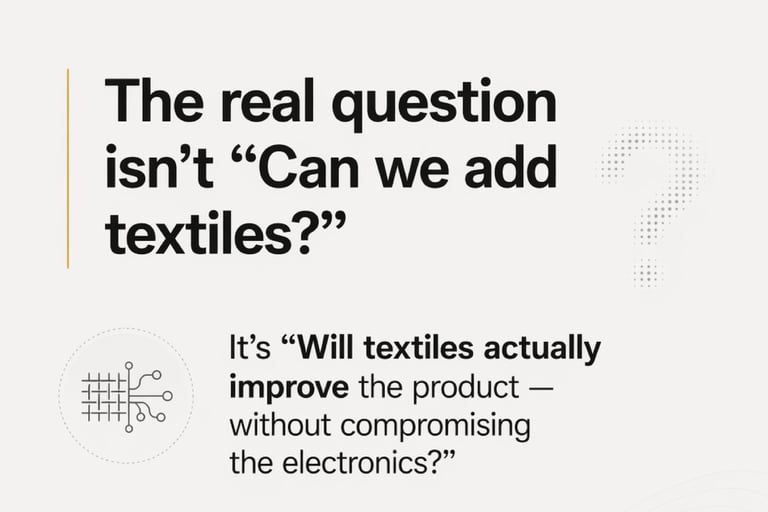
The real question is not simply:
Can we add textiles to this wearable?
The better question is:
Will textiles actually improve the product without creating bigger problems elsewhere?
That is where the decision should begin.
Why More Wearable Products Are Being Reconsidered as E-Textiles
As wearable products mature, the challenge is no longer only about whether the electronics work.
In many cases, the electronics already work well enough at the prototype level. The harder challenge is making the product comfortable, practical, reliable, and easy enough to use in real life.
This is especially important for products used in areas such as:
medical monitoring
sports performance
rehabilitation
workplace safety
continuous health tracking
movement analysis
smart garments
assistive technology
In these applications, the product is not just a device. It becomes something the user has to wear, trust, and keep using.
That is where textiles can become valuable.
A textile-integrated product can often offer a more natural form factor than a rigid device. It can distribute sensors across the body, reduce bulk, improve comfort, and make the technology feel less intrusive.
This is one reason many companies are now exploring e-textile product development services earlier in the product development process, instead of waiting until the electronics are already fully designed.
However, those benefits only matter if they solve a real product problem.
The Main Reasons Companies Move from Hard Wearables to Textile Integration
There are several common reasons why teams start exploring e-textiles.
1. Better Comfort for Long Wear Sessions
Hard wearable devices can become uncomfortable when worn for long periods. Pressure points, straps, rigid housings, and poor body conformity can all reduce user compliance.
For applications that require extended use, comfort is not just a nice feature. It directly affects whether the product will be used consistently.
Textiles can help distribute pressure more naturally and make the wearable feel closer to clothing rather than a device attached to the body.
2. More Consistent Body Conformity
Many wearable products rely on correct placement to collect useful data.
A textile-integrated system can sometimes help maintain better contact with the body, especially when the garment or textile structure is designed around the target anatomy.
This can be useful for products that need sensors placed across the torso, limbs, joints, or specific muscle groups.
3. Easier Distribution of Multiple Sensing Points
Hard wearable products can become bulky when multiple sensors are required.
E-textiles can make it easier to distribute sensors across a larger area while keeping the system more wearable. This is especially relevant in applications involving motion capture, posture tracking, muscle activity, pressure sensing, or multi-point physiological monitoring.
This is also where materials such as conductive fabrics, conductive yarns, printed conductors, embroidered pathways, and hybrid interconnect systems become important.
4. Better Aesthetics and User Acceptance
A product can be technically functional and still fail because users do not like wearing it.
Textile integration can improve the product’s appearance and reduce the feeling that the user is wearing a medical or technical device. This can be important in consumer, medical, workplace, and sports environments.
5. A More Natural Fit for Real-World Use
In many cases, the best wearable product is the one that feels the least like a product.
If users can put it on like clothing, move naturally, and forget about the technology, the chance of long-term adoption improves.
This is one of the strongest reasons to consider e-textiles.
For broader context, recent research on textile electronics for health monitoring also highlights flexibility, breathability, portability, and wearability as important reasons textile electronics are being explored for health monitoring applications.
When E-Textiles Actually Make Sense
A textile-integrated approach makes the most sense when the goal is to improve the overall wearable experience.
This usually includes one or more of the following:
comfort
wear duration
usability
sensor placement
body conformity
product acceptance
reduced bulk
overall product experience
If these are the main bottlenecks in the current wearable design, then e-textiles may be worth exploring.
For example, if a wearable sensor system works technically but is uncomfortable after 30 minutes, the problem is not only electronic. It is also mechanical, textile, ergonomic, and user-experience related.
In that situation, textile integration may provide a better product path.
But if the main challenge is only electronic performance, battery life, firmware, or enclosure protection, then moving into textiles may not solve the core issue.
That is why the decision needs to be made carefully.
Not Every Wearable Should Become an E-Textile
It is important to be clear about this:
E-textiles are not always the right answer.
Some wearable products are better kept as hard or semi-rigid devices.
A hard wearable may be more suitable when the product needs:
a rigid housing
precise mechanical alignment
strong impact protection
easy electronics replacement
simplified assembly
lower manufacturing complexity
a more conventional production route
In some cases, forcing textile integration can make the product more difficult to develop without creating enough value for the user.
This is why the early evaluation is so important.
The question should not be:
How do we make this wearable textile-based?
It should be:
What problem are we trying to solve by introducing textiles?
If the answer is not clear, the product direction may need to be reconsidered.
What Changes When a Wearable Becomes an E-Textile?
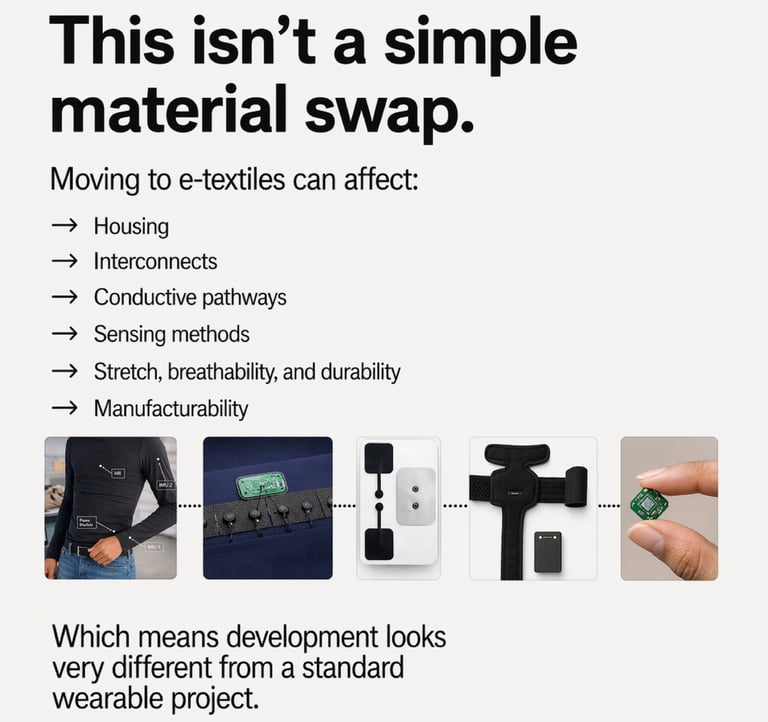
Moving from a hard wearable to an e-textile is not a simple material swap.
It can affect the entire product architecture.
A team may begin by thinking they are only changing the outer form of the product. But once textiles are introduced, many other parts of the system can change as well.
This is why successful development usually requires a team that understands both electronics and textiles. At E-Textile Wearables, our work is built around that exact intersection: electronics, textiles, materials, engineering, and manufacturing.
Housing
Traditional wearables often use hard housings to protect the electronics and define the product structure.
In an e-textile product, the housing strategy may need to change. Some electronics may still require rigid protection, while other parts may need to be integrated into soft or flexible areas.
This creates important design questions:
Which components need rigid protection?
Which components can be integrated into the textile?
How will the electronics be removed, serviced, or washed?
How will the housing interact with the fabric during movement?
Interconnects
Interconnects are one of the most critical parts of e-textile development.
In standard electronics, connectors are usually designed for controlled mechanical environments. In textiles, the system may experience stretching, bending, pulling, folding, washing, and repeated body movement.
A connector that works on a bench may fail when used in a garment or soft wearable.
That means the interconnect strategy needs to be considered early.
Conductive Pathways
In a hard wearable, conductive pathways are usually handled through wires, flex circuits, or PCBs.
In e-textiles, conductive pathways may involve conductive yarns, printed conductors, embroidered traces, laminated circuits, flexible cables, snaps, or hybrid textile-electronic structures.
Each option has trade-offs.
Important factors include:
resistance
stretchability
durability
washability
repeatability
connection reliability
manufacturing method
cost
Choosing the wrong conductive pathway can create problems later in development.
Sensing Methods
The sensing method may also change when moving into textiles.
Some sensors can be integrated into a textile structure. Others may need to remain as electronic modules attached to the garment. In many practical products, the best approach is hybrid: part textile, part electronic module.
The key is to understand how the sensor behaves in real use.
A sensor may perform well in a fixed test setup but behave differently when placed on a moving body, under fabric tension, or in contact with sweat and skin.
Stretch, Breathability, and Durability
Textiles are dynamic materials.
They stretch, compress, wrinkle, absorb moisture, and change shape during wear. These are not small details. They can directly affect product performance.
For example:
Stretch can change sensor placement.
Compression can affect contact quality.
Moisture can influence material behavior.
Washing can damage interconnects.
Repeated movement can create fatigue.
This is why textile behavior must be part of the engineering discussion from the beginning.
Manufacturability
A working e-textile prototype is not the same as a manufacturable e-textile product.
Manufacturing introduces another layer of complexity.
Teams need to think about:
repeatable assembly
supplier capability
quality control
inspection methods
process variation
manufacturing cost
repairability
testing plans
production scalability
If manufacturability is ignored too long, the project may reach a prototype that looks promising but is difficult to produce reliably.
This is why our services cover not only product development, but also validation, testing, manufacturing readiness, certification management, and production planning.
Why E-Textile Development Usually Requires Multiple Prototype Loops
E-textile development is rarely linear.
In many cases, teams need to move back and forth between functional validation and design refinement several times.
A first prototype may prove that the electronics can work.
The next prototype may focus on wearability.
Then another version may be needed to improve durability, sensor placement, interconnect reliability, or manufacturability.
This process often involves a back-and-forth between:
Engineering Validation
This stage focuses on whether the system works technically.
Questions include:
Are the sensors functioning?
Is the signal quality acceptable?
Are the electronics communicating properly?
Are the conductive pathways reliable?
Does the system meet the required performance level?
Design Validation
This stage focuses on whether the product works as a wearable.
Questions include:
Is it comfortable?
Does it stay in place?
Can the user wear it naturally?
Does it interfere with movement?
Does it survive repeated use?
Is the product practical in the intended environment?
Iteration Between Both
In e-textiles, engineering and design are closely connected.
A design change can affect signal quality.
A sensor placement change can affect comfort.
A textile construction change can affect durability.
A manufacturing decision can affect electronics integration.
This is why iteration is normal and necessary.
The teams that struggle are often the ones that expect e-textile development to behave like a standard electronics project.
This is also why it helps to look at real examples and application areas. Our projects page shows the kinds of spaces where textile-integrated wearables can be relevant, including sports gear, medical technology, industrial wearables, and fashion-forward smart garments.
The Biggest Mistake: Treating E-Textiles as an Electronics Problem Only
One of the most common mistakes in e-textile development is treating the project purely as an electronics challenge.
Electronics are important, but they are only one part of the system.
Successful e-textile products live at the intersection of:
electronics
textile engineering
manufacturing
user experience
A product can pass every bench test and still fail in real use.
That failure may not come from the circuit board.
It may come from the textile.
For example:
the sensor shifts during movement
the garment does not fit consistently across users
the connector fails after repeated bending
the textile stretches more than expected
the user finds the product uncomfortable
the assembly process is not repeatable
the product cannot be washed or maintained properly
These are not secondary issues. They are core product issues.
That is why e-textile development needs to be approached as a complete system, not as electronics placed onto fabric.
A recent review on smart textiles, IoT integration, and human-centric design also reflects this broader direction in the industry, where smart textile development is increasingly connected to sensing, communication, user comfort, sustainability, and real-world usability.
What Successful E-Textile Teams Do Differently
Strong e-textile development teams usually approach the product differently from the start.
They Start with the Use Case
They first understand what the product needs to achieve in real use.
This includes the user, environment, wear duration, body location, movement, comfort requirements, and performance expectations.
They Define the Reason for Textile Integration
They do not use textiles just because it sounds advanced.
They use textiles because it improves something meaningful in the product.
They Consider Textile Variables Early
They think about stretch, breathability, fit, construction, washability, and durability early in the process.
These factors are not left until the end.
They Test in Realistic Conditions
Bench testing is useful, but it is not enough.
E-textile products need to be tested in conditions that represent real use.
This may include wearer testing, stretch testing, bend testing, twist testing, wash testing, dry testing, and environmental testing depending on the product.
They Plan for Manufacturing Earlier
Manufacturing cannot be an afterthought.
The integration method, supplier capability, quality assurance process, and cost structure should be considered before the design becomes too fixed.
This is especially important for startups and product teams that need to move from a working prototype to a market-ready product.
A Practical Checklist Before Moving a Wearable into Textiles
Before deciding to redesign a wearable as an e-textile, it helps to ask a few practical questions.
Product Fit
What problem will textile integration solve?
Is comfort a major product limitation?
Does the product need long wear duration?
Does the product require multiple sensing points?
Does the current wearable format limit usability?
Technical Feasibility
Will textile integration affect signal quality?
Can the sensor placement remain consistent?
How will interconnects be handled?
Which components need rigid protection?
Which parts can safely become soft or flexible?
User Experience
Will the product be easier to wear?
Will the user accept it as part of their routine?
Will it restrict movement?
Will it feel natural during real use?
Durability and Maintenance
Does the product need to be washable?
Will it experience repeated bending or stretching?
How will sweat, moisture, and cleaning affect performance?
Can the system survive repeated use?
Manufacturing
Can the design be produced consistently?
Are the materials and suppliers available?
Can the product be tested at scale?
Is there a clear quality control process?
Is the cost structure realistic?
If the answers are unclear, the project may need more feasibility work before moving forward.
Final Thoughts
The future of wearables is not only about making devices smaller.
In many cases, it is about making technology integrate more naturally into the things people already wear.
That is the opportunity with e-textiles.
But the best e-textile products are not simply the ones that look more advanced. They are the ones users actually keep wearing.
To get there, textile integration has to be treated as a product development strategy, not just a material change.
When done properly, e-textiles can improve comfort, usability, sensing integration, and long-term user acceptance.
When done poorly, they can make a product more complex without solving the right problem.
The difference comes down to asking the right question early:
Will textiles truly improve the product?
If the answer is yes, then the next step is to design, validate, and manufacture the product as a complete textile-electronic system.
Exploring Whether Your Wearable Product Can Become an E-Textile?
At E-Textile Wearables, we help teams evaluate, prototype, test, and develop textile-integrated wearable products.
Whether you are trying to improve comfort, distribute sensors, reduce bulk, or move from a hard wearable format into a textile-based system, the first step is understanding whether textile integration is the right product strategy.
You can learn more about our e-textile and wearable technology services, explore our work and application areas, or contact us to discuss your project.
Hard wearables to textile integrated products


Contact
Let’s talk about your next E-Textile project
© 2025. All rights reserved.