Why Swatch-Level Wash Testing Is Not Enough for E-Textiles
Swatch-level wash testing is useful in e-textile development, but it does not always predict how a finished garment will perform in real wash and dry cycles.
3/12/20264 min read
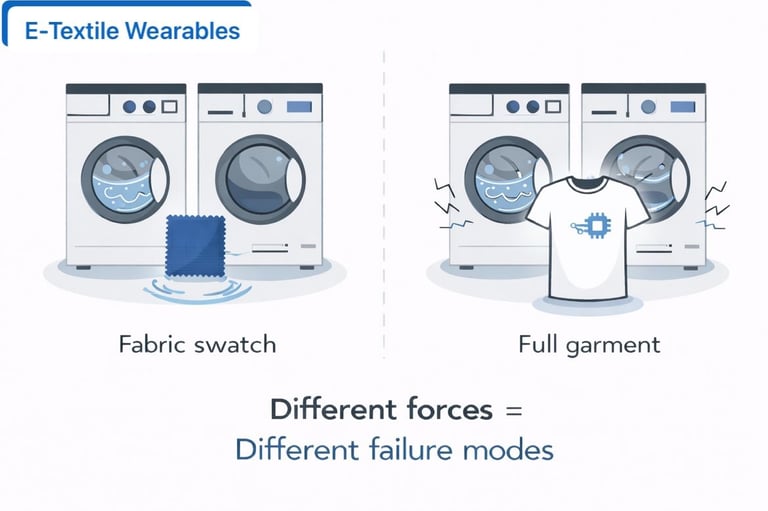
A swatch that passes wash testing is a useful signal - but it is not the same as proving the final garment will survive real wash and dry cycles.
Wash durability is one of the most important challenges in e-textile product development.
Many teams begin by testing a tech-integrated fabric swatch. That is a smart first step. It helps developers compare materials, integration methods, and early construction ideas before moving into full product builds.
But there is one important problem.
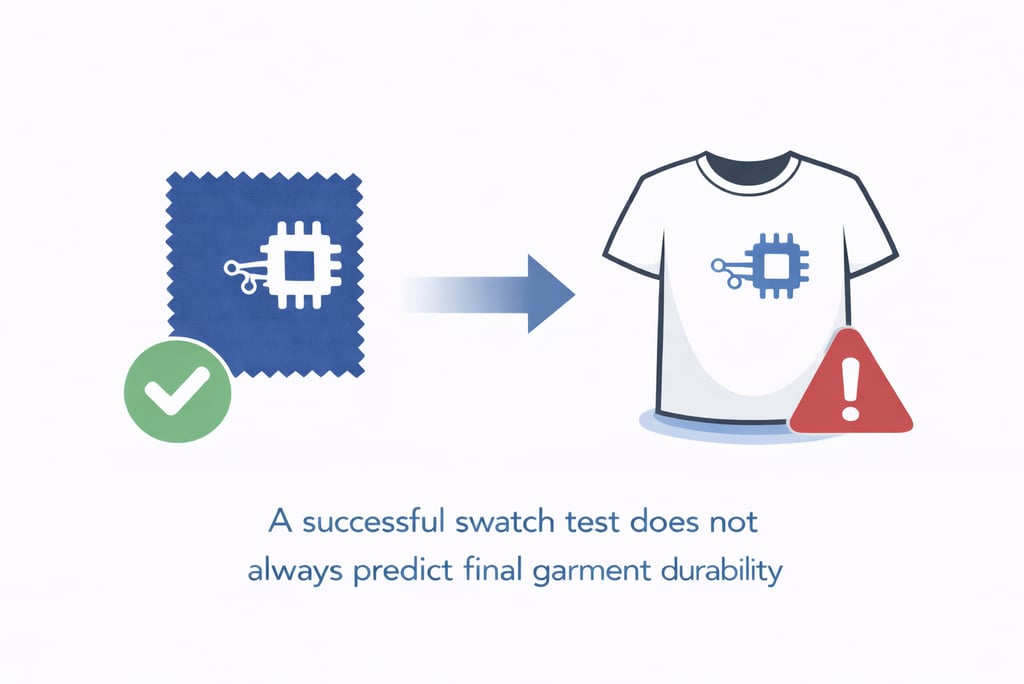
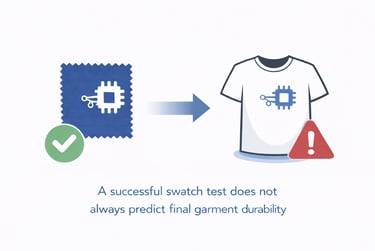
A fabric swatch that performs well in wash testing does not always mean the final garment will perform the same way.
That is because a swatch and a finished garment do not experience the same mechanical forces inside the washer and dryer.
What is swatch-level wash testing in e-textiles?
Swatch-level wash testing is usually done on a smaller textile sample that contains part of the technology stack. This may include conductive materials, printed traces, embroidered circuits, bonded layers, sensors, or heating elements.
This type of testing is useful because it allows teams to evaluate an idea early, reduce development risk, and compare options faster.
For readers who are new to the field, our guide to electronic textiles (e-textiles) gives a broader overview of how electronics are integrated into textile systems.
Swatch testing is valuable, but it is still only one part of the full durability picture.
Why a full garment behaves differently in the wash
Once the same technology is built into a full garment, the testing environment changes.
A finished product has seams, hems, folds, trims, multiple panels, and more mass. It may also include pockets, connectors, modules, strain points, and areas where the textile is repeatedly bent or twisted during washing and drying.
All of these details affect how forces move through the product.
A flat swatch may go through a laundering cycle in a relatively controlled way. A full garment does not. It tumbles differently, folds differently, stretches differently, and creates different stress points across the electronic and textile system.
This is why recognized textile testing frameworks such as ISO 6330 and AATCC laundering guidance are useful reference points when thinking about wash and dry performance in textile products.
Different forces can create different failure modes
This is where developers can get a false sense of confidence.
A swatch may survive early testing, but the final product may still fail once garment-level dynamics are introduced.
Mechanical failure modes
At the garment level, extra movement can lead to cracking, fatigue, detachment, or breakage in areas that were not stressed the same way at swatch level.
In many cases, the problem does not come from the base textile itself. It comes from how the electronic system interacts with seam lines, folded zones, garment construction details, or areas of repeated impact inside the machine.
Electronic failure modes
Full garment testing can also expose electronic failures that do not appear on small samples.
These may include intermittent connections, failures near module interfaces, movement-related strain on interconnects, or performance drift after repeated wash and dry cycles.
This becomes even more important when electrical performance depends heavily on the textile substrate. As explained in our article on conductive fabrics, repeated washing, stretching, and environmental exposure can affect resistance and overall system performance.
Why this matters in product development
The later you discover these issues, the harder they are to fix.
If a product only reaches full garment wash testing after major design decisions are already locked, the team may need to revisit materials, construction, module placement, attachment methods, or the overall system architecture.
That can mean more cost, more delays, and more development rework.
This is why real durability validation should not stop at the swatch level.
At E-Textile Wearables, we see product validation as more than just checking whether a sample survives a wash cycle. It is about understanding how the full product behaves under real use conditions, including twist, bend, stretch, wash, tumble dry, and wearer-related stresses.
A better way to approach wash durability in e-textiles
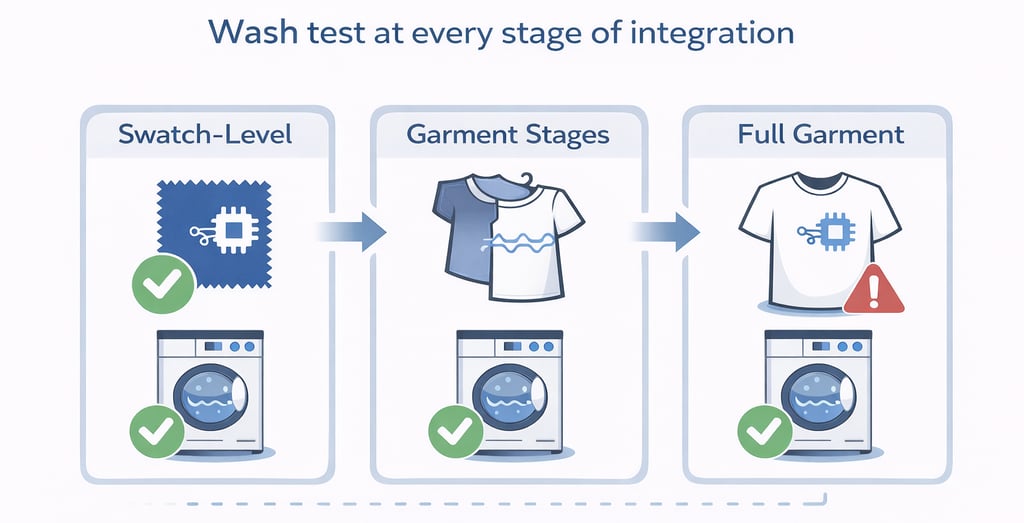
A stronger development strategy is to treat testing as a progression.
Start with swatches to screen materials and integration concepts.
Then move to larger assemblies or partial builds where needed.
Then test the full garment as a complete working system.
Most importantly, evaluate both textile integrity and electronic performance throughout the process.
A product that still looks visually acceptable after washing is not necessarily passing. The system also needs to maintain the required function.
This is especially true for products that rely on conductive pathways, heating elements, or embedded sensing systems. Our articles on conductive fabrics, heating garments, and the difference between smart textiles and electronic textiles are useful references for anyone designing products in this space.
Final thoughts
Swatch-level wash testing is useful.
But in e-textiles, it should never be the only proof of durability.
A finished garment behaves differently in the washer and dryer, and those differences can reveal failure modes that are easy to miss early in development.
That is why passing a swatch test is a good sign, but not the final answer.
In many cases, the real test begins when you evaluate the whole product.
If you are developing an e-textile product and need support with wash durability, testing strategy, or failure analysis, contact us to discuss your product and development challenges.
Contact
Let’s talk about your next E-Textile project
© 2025. All rights reserved.